
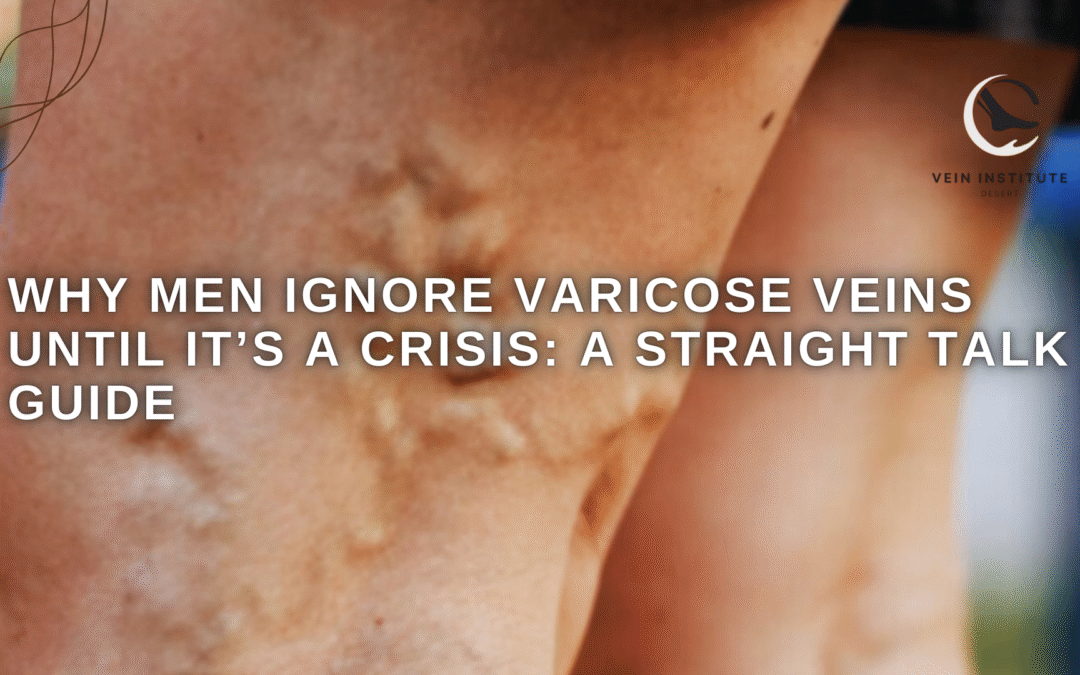
Why Men Ignore Varicose Veins Until Crisis 🚹⚠️
I have practiced venous medicine long enough to recognize a pattern: men rarely come in early. They arrive when the discomfort becomes disruptive, when swelling no longer fits into their shoes, or when a sudden complication forces action. By then, what began as visible varicose veins has often progressed to chronic venous insufficiency.
This is not about vanity. It is about physiology and timing. Veins do not fail overnight. They deteriorate gradually, sometimes silently, until pressure, inflammation, and tissue damage reach a tipping point. The title why men ignore varicose veins reflects what I see repeatedly in men between 40 and 60 — capable, resilient individuals who tolerate symptoms far longer than they should.
In Palm Desert’s warm climate, where heat promotes vein dilation and outdoor activity is common, untreated venous disease can accelerate more quickly than expected.
Why Men Ignore Varicose Veins Until Crisis, The Behavioral Pattern 🧠
Men often describe early symptoms as “just fatigue” or “normal aging.” Aching calves after work, ankle swelling at night, or visible rope-like veins are dismissed as minor inconveniences.
Several factors contribute to delay:
1️⃣ Symptoms progress gradually, making adaptation easy
2️⃣ Pain is intermittent rather than constant
3️⃣ Cosmetic concerns feel secondary
4️⃣ Work and family responsibilities take priority
However, veins operate under constant gravitational stress. When valve function weakens, blood reflux increases pressure in the lower extremities. Over time, this pressure damages surrounding tissues.
Ignoring the issue does not stabilize it. It allows chronic inflammation to persist.
What Happens When Treatment Is Delayed ⏳
Untreated venous insufficiency can evolve beyond visible bulging veins. Persistent venous hypertension may lead to:
• Skin thickening and discoloration near the ankles
• Eczema-like irritation
• Recurrent swelling
• Superficial thrombophlebitis
• Venous ulcers in advanced cases
By the time a patient presents with skin breakdown or sudden severe pain, intervention becomes more complex. Early-stage procedures are typically minimally invasive and highly effective. Advanced disease requires longer recovery and closer monitoring.
The crisis point often arrives unexpectedly — a bleeding varicose vein after minor trauma, sudden inflammation, or a non-healing wound.
The Silent Energy Drain 🔋
Many men do not connect leg symptoms with systemic fatigue. Yet inefficient venous return forces the body to compensate. Muscles receive less optimal oxygen exchange. Fluid retention increases tissue pressure. Evening heaviness discourages physical activity.
Reduced activity further weakens the calf muscle pump, worsening circulation. This cycle is subtle but measurable. Energy levels decline gradually, reinforcing inactivity.
In clinical discussions about why men ignore varicose veins until crisis, fatigue is often the hidden factor they failed to attribute to circulation.
Straight Talk About Risk Factors 📊
Venous disease does not discriminate, but certain factors increase progression:
• Family history of vein disorders
• Occupations requiring prolonged standing
• Obesity
• Prior leg injury
• Age-related valve weakening
Heat exposure, common in California’s desert environment, contributes by expanding superficial veins and increasing venous pooling.
Acknowledging risk is not a sign of weakness. It is preventive medicine.
Modern Solutions Are Not What They Used to Be 🩺
One reason some men delay care is outdated perception. They imagine invasive surgery or extended downtime. Contemporary vein treatment relies primarily on ultrasound-guided, minimally invasive techniques performed in-office.
Procedures target refluxing veins while preserving healthy circulation. Most patients resume normal activities quickly. Early intervention prevents the escalation that defines crisis-stage disease.
Information about evaluation and treatment options is available at https://theveininstituteofthedesert.com/.
Taking Action Before Crisis Improves Outcomes 🚦
The message behind Why Men Ignore Varicose Veins Until Crisis is not criticism — it is clarity. Venous disease progresses predictably when left untreated. Addressing symptoms early reduces inflammation, restores more efficient circulation, and prevents complications.
If you notice:
• Persistent leg heaviness
• Visible bulging veins
• Swelling that worsens by evening
• Skin color changes near the ankles
It is time for evaluation, not endurance.
Veins rarely repair themselves. They respond to proper diagnosis and targeted care. Waiting for a crisis transforms a manageable condition into a disruptive one.
Strength is not measured by how long discomfort is tolerated. It is measured by decisive action that protects long-term health and mobility.
Andy Sharify
The founder and owner of The Vein Institute of the Desert. He oversees the clinic, ensuring exceptional service and a patient-focused approach to vein care. Andy is dedicated to creating a comfortable and supportive environment for every patient.